Denver • 4th Wed of every month

Where Denver's AI Leaders
meet, learn, and build.
A monthly community for operators, technologists, founders, and executives applying AI to real business outcomes.
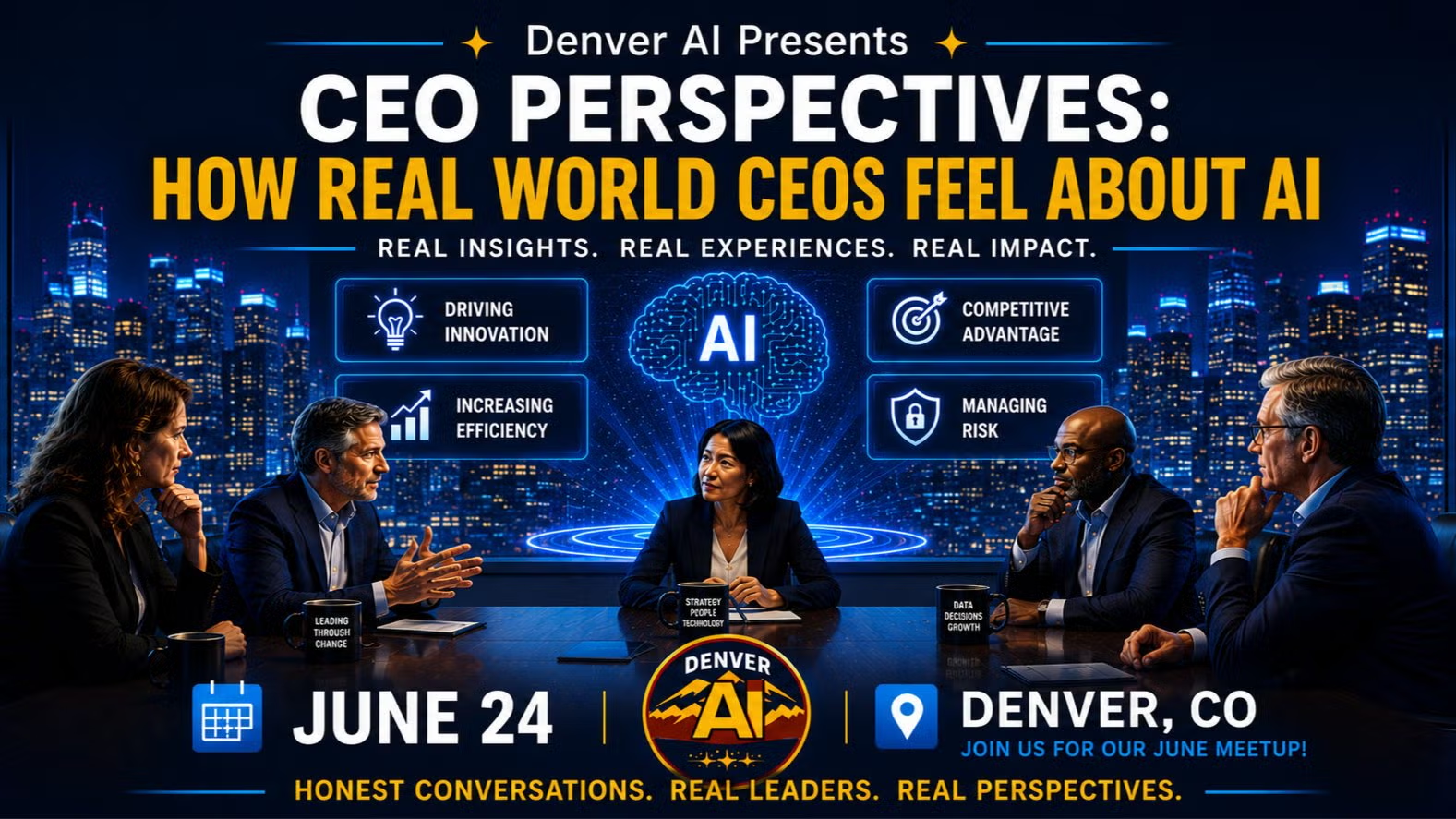
June 2026:
Denver AI: CEO Perspectives: How Real-World CEOs Feel About AI
One central message:
Artificial Intelligence has moved from experimentation to executive decision-making.
Rather than discussing futuristic possibilities, the conversation centered on how CEOs are navigating AI today—balancing opportunity, uncertainty, and the realities of implementing AI inside organizations.
Major Themes:
1. AI is now a business strategy conversation—not just a technology conversation.
Executives described AI as affecting virtually every part of their organizations, including:
-
- Strategic planning
- Operations
- Hiring and workforce planning
- Customer experience
- Product development
- Budget allocation
- Competitive positioning
- Many organizations are no longer asking whether they'll use AI, but where it will create the most value.
2. Practical value is beginning to emerge.
Rather than replacing entire jobs, CEOs discussed AI as a tool that can:
Increase employee productivity
Reduce repetitive administrative work
Accelerate research and analysis
Improve customer responsiveness
Support faster decision making
Enhance knowledge sharing
The emphasis was on augmentation rather than wholesale replacement.
3. Leaders remain cautious.
Despite excitement, executives expressed concerns around:
Accuracy and hallucinations
Data privacy
Security
Governance
Regulatory uncertainty
Intellectual property
Brand reputation
Ethical use of AI
Many organizations are intentionally moving forward through controlled pilots instead of enterprise-wide deployments.
4. Internal adoption is often harder than the technology itself.
Successful AI adoption depends on people, not just tools.
Common organizational challenges include:
Employee resistance
Fear of job displacement
Lack of AI literacy
Training needs
Change management
Establishing clear policies
Building trust
Leadership communication and education were viewed as essential.
5. The gap between AI hype and reality is significant.
The discussion emphasized avoiding sensational headlines and focusing instead on measurable business outcomes.
Key questions included:
Does this solve a real problem?
Does it improve productivity?
Is it sustainable?
Will employees actually use it?
Can it be governed responsibly?
6. Competitive pressure is accelerating adoption.
Many leaders acknowledged that AI has become a competitive necessity.
Organizations are increasingly concerned about:
Falling behind competitors
Meeting customer expectations
Maintaining operational efficiency
Attracting talent
Remaining innovative
The challenge is determining where AI creates strategic advantage rather than adopting it simply because it is trending.
7. Boards and customers are asking new questions.
Executives reported growing expectations from stakeholders regarding AI.
Questions now coming from boards, investors, and customers include:
What is our AI strategy?
How are we using AI responsibly?
What safeguards exist?
What productivity gains are expected?
How does AI support long-term competitiveness?
AI governance is becoming a leadership responsibility, not solely an IT function.
Community Highlights
The evening also featured:
Networking during the Denver AI social hour
Community announcements from Denver AI and the Rocky Mountain AI Interest Group (RMAIIG)
Demonstrations of practical AI applications in business
Continued discussion during the "Après AI" networking session
These elements reinforced Denver AI's emphasis on community learning and sharing practical experiences.
Overall Takeaway
The strongest message of the evening was that AI has entered mainstream business operations. Organizations are moving beyond curiosity and experimentation toward thoughtful, strategic implementation.
Success with AI will depend not only on selecting the right technologies, but also on building organizational readiness through leadership, governance, workforce development, and continuous learning.
The conversation reflected a shift from asking "What can AI do?" to asking "How can AI create measurable value while managing risk?"
For professionals in learning, workforce development, organizational leadership, and technology, the discussion underscored the importance of developing AI literacy, guiding responsible adoption, and helping organizations integrate AI into everyday work in ways that enhance—not replace—human capability.